


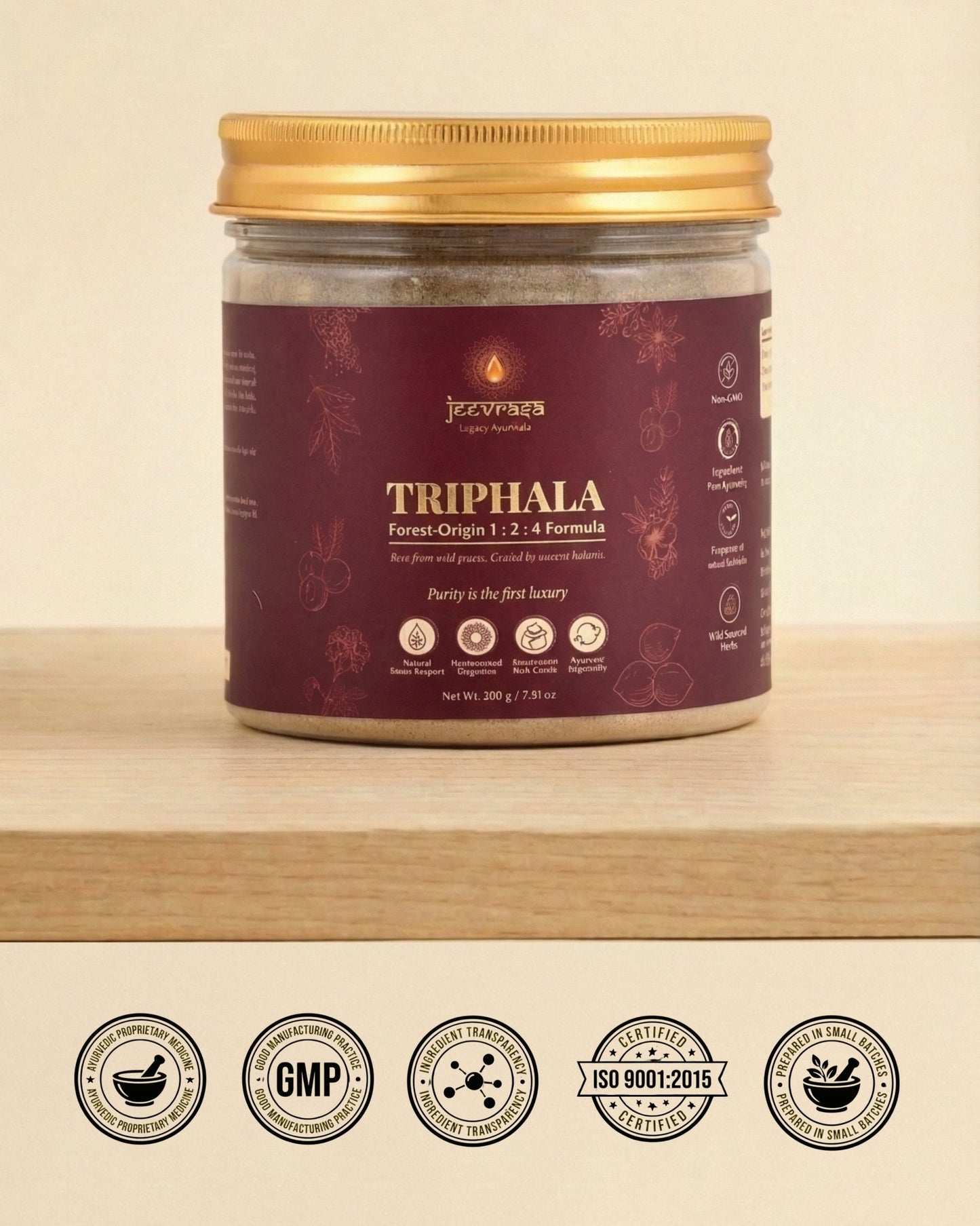
Triphala Powder Classical 1:2:4 Ratio (Wild Forest Sourced)
Triphala Powder Classical 1:2:4 Ratio (Wild Forest Sourced)
Regular price
Rs. 499.00 INR
Regular price
Rs. 499.00 INR
Rs. 499.00 INR
Sale price
Unit price
Rs. 2.50
per
g
Shipping calculated at check out.
Classical 1:2:4 Ratio · Wild Forest Sourced · Exact Gram Weights Declared
Most Triphala is 1:1:1. Equal parts, easy to manufacture, classical only in name. This one follows the 1:2:4 ratio — Amalaki dominant, as the texts prescribe. Wild forest sourced. Potent Herbs. Exact gram weights on every jar.
Free shipping above ₹999 · GMP Certified · AYUSH Approved · Wild forest sourced · Exact gram weights declared
- Classical Ayurvedic Formulation
 Crafted in a Classically Aligned Ratio
- Forest-Sourced Botanicals
Description
Description
JeevRasa Triphala is not a generic Triphala.
The three fruits exist in every brand's version. The difference is the ratio. Most commercial Triphala uses equal parts — 1:1:1. It is easier to manufacture and easier to market. It is not how classical Ayurvedic texts prescribe the formula.
The 1:2:4 ratio — Haritaki (1 part), Bibhitaki (2 parts), Amalaki (4 parts) — reflects the classical understanding that each fruit plays a different role at a different weight. Amalaki at 4 parts anchors the Rasayana dimension. Bibhitaki at 2 parts handles detox and respiratory clearance. Haritaki at 1 part moves the system — present enough to activate, restrained enough not to overwhelm.
A published comparative study found the 1:2:4 ratio outperformed 1:1:1 for metabolic balance. Classical wisdom, now validated.
Wild forest sourced. Potent Herbs. Exact gram weights declared on every jar.
This Triphala is designed to restore rhythm, not provoke it.
Key highlights
Key highlights
· Classical 1:2:4 ratio — Haritaki 14.3g · Bibhitaki 28.6g · Amalaki 57.1g per 100g. Exact gram weights declared. Not 1:1:1.
· Wild forest sourced — all three fruits wild-harvested by tribal collectors. No commercial farming. No contract cultivation.
· Stone grounded — classical processing that refines texture and enhances assimilation.
· Powder format — more bioavailable than capsules or tablets. Classical texts recommend churna with warm water for direct gut integration.
· Designed for daily long-term use — supports digestive rhythm, gentle elimination, and systemic Rasayana without dependency or urgency
Why 1:2:4 — and not equal parts?
Why 1:2:4 — and not equal parts?
Most Triphala on the market uses a 1:1:1 ratio — equal parts of all three fruits. It is easier to source, easier to manufacture, and easier to market as “balanced.” It is also not what the classical Ayurvedic texts prescribe.
The 1:2:4 ratio reflects the different roles each fruit plays in the formula:
Haritaki — 1 part (14.3g per 100g)
The “king of medicines” in classical Ayurveda. Haritaki is potent — it moves Vata, activates elimination, and kindles Agni. It is used in the smallest quantity because its action is strong. More is not better.
Bibhitaki — 2 parts (28.6g per 100g)
The respiratory and digestive detoxifier. Bibhitaki clears Kapha accumulation — in the lungs, the gut, and the metabolic channels. At 2 parts, it provides sustained detox support without dominating the formula.
Amalaki — 4 parts (57.1g per 100g)
The Rasāyana anchor. Amalaki is the highest natural Vitamin C source in classical Ayurveda, a systemic rejuvenator, and an anti-aging herb referenced across major Samhitas. At 4 parts, it ensures the formula rebuilds as it cleanses — not just purges.
A published comparative study found the 1:2:4 formulation outperformed equal-parts Triphala for metabolic balance effects.
This is the ratio. This is the formula. Every jar of JeevRasa Triphala declares the exact gram weights — not because we have to, but because you deserve to know what you are taking.
Three fruits. Three roles. One classical formula.
Three fruits. Three roles. One classical formula.
Each fruit in Triphala has a distinct identity, a distinct Rasa (taste), and a distinct action in the body. The formula works because of the relationship between them — not despite their differences.
3 FRUIT ENTRIES
Haritaki (Terminalia chebula) — 14.3g per 100g · 1 part
Sanskrit meaning: “That which carries away disease”
Rasa: Five of the six tastes (all except salty)
Role: Deepana (kindles digestive fire), Anulomana (gentle downward movement), Rasayana (rejuvenation).
The most comprehensive single herb in the Ayurvedic pharmacopeia. Used at 1 part because its action is potent — present enough to activate, restrained enough not to overwhelm.
Classical reference: “Haritaki is the king of herbs” — Charaka Samhita
Bibhitaki (Terminalia bellirica) — 28.6g per 100g · 2 parts
Sanskrit meaning: “That which keeps away fear (of disease)”
Rasa: Astringent dominant
Role: Respiratory tonic, detoxifier, Kapha-clearer. Supports lungs and upper respiratory channels. Cleanses the metabolic channels that Haritaki moves.
Often underrepresented in commercial Triphala — here it is correctly proportioned.
Classical reference: Sushruta Samhita — Bibhitaki for Kapha-dominant conditions
Amalaki (Emblica officinalis) — 57.1g per 100g · 4 parts
Sanskrit meaning: “The mother” (nurturing, nourishing)
Rasa: Sour dominant with all six tastes
Role: Rasayana anchor — systemic rejuvenator, Vitamin C source, anti-aging, cellular renewal.
At 4 parts, it ensures the formula is restorative, not just cleansing. This is what makes Triphala suitable for daily long-term use.
Classical reference: “There is nothing in this world more capable of protecting the body than Amalaki” — Charaka Samhita, Chikitsa Sthana
How to Take Triphala
How to Take Triphala
Dosage: 2–4g with lukewarm water, once or twice daily
Timing:
At bedtime — classical Ayurveda recommends Triphala churna at night for morning elimination
Alternative:
Morning on an empty stomach for Rasayana benefits
How to measure:
1 teaspoon ≈ 3g. Begin with 2g and increase to 4g after the first week
With:
Lukewarm water. Honey in spring. Jaggery in winter (classical seasonal anupana)
Duration:
Safe for daily long-term use. Not habit-forming
Not recommended:
During pregnancy or lactation without physician guidance
Storage:
Airtight container, cool dry place. Away from moisture and sunlight
Note:
Mild loose stools may occur in the first 3–5 days as digestive channels are cleared. This is expected and resolves with continued use at the right dose.
Why powder — not a capsule?
Why powder — not a capsule?
Triphala capsules are convenient. They are also a modern format that classical Ayurveda never intended for this formula.
The Rasa (taste) of Triphala — its astringent, sour, bitter profile — is part of its therapeutic action. When you taste Triphala, your digestive intelligence responds. Saliva production begins. Agni is kindled. The gut prepares.
A capsule bypasses all of this. You swallow it and the herbs arrive in the stomach without the preparatory signal that the taste should have sent.
Classical texts prescribe Triphala as churna (powder) mixed with warm water — specifically because the taste-to-digestion signal chain is part of the medicine.
JeevRasa Triphala is a powder because that is what the formula was designed to be. The glass jar preserves potency without plastic leaching. The dosage is flexible — start with 2g, adjust to 4g over time.
Begin gently. Let the forest work.




R
This Triphala formula has helped me in my bloating issues and I feel resurge of a new energy which was earlier not felt. Recommended
P
Well it is very good, one thing I am interested to know, can it be taken with "shahad" to lessen its bitter taste?
J
Nice one...
Recently Viewed

Triphala Powder Classical 1:2:4 Ratio (Wild Forest Sourced)
Regular price
Rs. 499.00 INR
Regular price
Rs. 499.00 INR
Rs. 499.00 INR
Sale price
Unit price
Rs. 2.50
per
g
